Modular construction allows for a faster building process, but is it better?
"We are noticing a surge in interest as construction developers are trying alternate ways to build," said Tracey Daniels, communications director for Modular Building Institute, an international nonprofit trade association based in Charlottesville, Va.
Modular construction is a process where portions of the project are built off site. Once together and sealed, the modules become one integrated wall, floor and roof assembly, according to the organization's website. Structurally, modular buildings generally are stronger than conventionally constructed buildings because each module is engineered to independently withstand the rigors of transportation and crane lifting onto foundations.
Modular construction, which includes both permanent and movable buildings, reduces waste through factory production, Daniels said.
Once together and sealed, the modules become one integrated wall, floor and roof assembly, according to the organization's website.
Daniels said as bigger companies – such as Skanska, based in Blue Bell, and Whiting-Turner Contracting Co., based in Allentown, take on or incorporate modular elements to their projects, smaller companies are beginning to do so, too.
Another benefit is time savings, she said. Instead of having to wait for site work to be done, construction on the building can take place simultaneously, allowing for projects to be done more efficiently.
"You can shave 30 to 50 percent off of the timeline," Daniels said.
Modular construction also is used frequently for urban housing, hotels, hospitals and schools to allow for minimal site disruptions and to reduce on-site traffic, she said.
One of the main points to consider is that if modular construction is the chosen method, it should be decided early in the design process, since it can be harder and more costly to redesign a project, she said.
Modular construction's impact on boosting productivity could be enhanced with the growth of green buildings and technology.
According to a 2011 Smart Market Report from McGraw Hill Construction on "Prefabrication and Modernization: Increasing Productivity in the Construction Industry," the re-emergence of pre-fab and modular as a new trend is tied to the rise of building information modeling (or BIM, which uses software to create 3-D project designs). It also is connected to the increasing interest in green buildings, which influences design and construction processes.
The report takes a look at pre-fab and modular processes and their impact on productivity metrics for the construction industry, including costs, safety, project schedules, quality, eliminating waste and creating green buildings.
The findings from a survey of 809 contractors, architects and engineers showed that:
• 66 percent report that project schedules are decreased; 35 percent said by four weeks or more.
• 65 percent report that project budgets are decreased; 41 percent said by 6 percent or more.
• 77 percent report that construction site waste decreased; 44 percent said by 5 percent or more.
With increasing interest in lean construction, the strong influence of green construction and the rising use of BIM technologies, these factors make pre-fab and modular process a critical trend in the construction industry, the report said.
Here is a useful link to an article about construction waste and modular construction.
http://constructioninformer.com/2013/02/19/modular-construction-promises-less-construction-waste/
And another about a recent modular construction project at Muhlenberg College in Allentown.
http://www.nrb-inc.com/us/dormitories-accomodation/commerical-modular-buildings/three-story-dorm-addition#
Pedersen Brian ( 2013 December 06) Can modular construction boost productivity? Retrieved on December 11, 2013 From LVB.com.

Showing posts with label modular construction company. Show all posts
Showing posts with label modular construction company. Show all posts
Thursday, December 12, 2013

Friday, June 28, 2013
Modular Construction for Emergency Housing Solutions

Mother
nature has unleashed her fury this year with all sorts of disastrous storms. Hurricanes, tropical storms, earthquakes and
tornadoes have displaced large numbers of residents and businesses. Government agencies immediately stepped in to
help victims by providing food, water and emergency shelters.
After
these initial steps, areas struck by natural disasters often look to rebuild. Most look for an immediate temporary solution
to begin, and then consider permanent solutions for the future. Portable disaster housing is the only choice
in many scenarios because it provides immediate relief.
Traditional
housing solutions often take too long to construct and sometimes, new
construction is not feasible with the poor ground conditions caused by the
storm and damage and debris. In
emergencies, modular construction has become the
housing solution of choice because the buildings are primarily
constructed off-site and there is less impact to the environment.
Modular buildings and homes come in a variety of sizes and finishes to meet the needs
of the specific emergency at hand. They
can be customized to meet your exact space needs and if needed immediately,
pre-leased modular buildings can often be quickly refurbished and delivered. Modular units are far easier to transport and
assemble than traditional disaster housing units.
When
a disaster strikes, the best emergency response shelters and buildings should
be available to those in need. Modular emergency response buildings ensure you will receive a quality home quickly to
assist in recovery efforts.
Thursday, March 7, 2013
Research Proclaims MH Rising
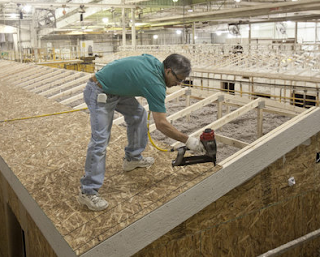
As PRWeb informs MHProNews, according to market research firm Global Industry Analysts, Inc. (GIA), shipments of prefabricated homes are expected to reach 112,000 units by 2018 in the U.S. as the resurgence in housing and construction activity increases.
The study covers manufactured, modular, panelized, and precut housing, but the manufactured housing segment comprises over half of the total shipments. Single-section growth of manufactured homes is expected to grow at a compound annual growth rate (CAGR) of 9.9 percent for the next five years. While the rising demand for prefab housing is coming from the baby boomers, it is also driven by environmental awareness from those desiring eco-friendly and energy efficient homes which are being incorporated into factory-built product.
Growth in this market in the U.S. has been stymied by the lack of financial support and incentives from the federal government, as well as by the ‘trailer park’ mentality long associated with the industry as a whole.
Photo credit: Chris Butler/Idaho Statesman
Source: http://www.mhmarketingsalesmanagement.com/blogs/daily-business-news/research-proclaims-mh-rising/
Written By: Matthew Silver
Tuesday, January 15, 2013
Expanding Your Business The Modular Way
Fast Turnaround Time
Modular construction is the perfect choice for small and large businesses looking to expand. Because modular building construction and site work occur simultaneously, projects can be completed 30-50 percent faster. This allows overcrowded offices to expand quickly and accommodate more clients and staff. Additionally, expanding businesses can open new locations faster.
Modular A Greener Option?
Modular construction is a resource efficient and environmentally friendly building option. Modular construction in a factory controlled setting results in less material waste and improved air quality. Additionally, entire buildings or parts can be reused.
Future Expansion Is Possible
Modular buildings are built to allow for future expansion. A building can be set on a permanent or temporary foundation and can be relocatable, depending on the business’s need. Modular buildings allow for greater flexibility and future relocatability.
No Disruption To The Business
Because a great deal of the construction happens in the factory, there is less disruption to the businesses daily functions. A business owner can continue operating their business uninterrupted and not have to worry about the distracting construction process that may turn off customers.
Modular construction is one option available to businesses that are looking to expand their operations in a timely manner without compromising quality or efficiency.
Modular buildings are built to allow for future expansion. A building can be set on a permanent or temporary foundation and can be relocatable, depending on the business’s need. Modular buildings allow for greater flexibility and future relocatability.
No Disruption To The Business
Because a great deal of the construction happens in the factory, there is less disruption to the businesses daily functions. A business owner can continue operating their business uninterrupted and not have to worry about the distracting construction process that may turn off customers.
Modular construction is one option available to businesses that are looking to expand their operations in a timely manner without compromising quality or efficiency.
Subscribe to:
Posts (Atom)